B2B Video Surveillance India
by Satyajit Roy
The Indian video surveillance market is no longer a race to the bottom for the cheapest hardware. Valued at over USD 4.8 Billion in 2026, the industry is expanding at a double-digit CAGR. What was once a passive, reactive tool for recording footage has evolved into a proactive, intelligent B2B ecosystem.
Driven by the Smart Cities Mission, automated traffic management (e-challans), and strict RBI compliance mandates for BFSI data storage, B2B buyers are shifting their focus from “megapixels” to “actionable data.”
As we approach FY 2026-27, enterprise security leaders, system integrators, and OEMs must move past outdated broad-strokes marketing. To capture the Indian enterprise, you must segment the market based on the technological and architectural trends defining this fiscal year.
Here is how the Indian B2B CCTV market is segmenting in FY 2026-27.
3 Macro-Trends Governing FY 2026-27 Procurement
Before segmenting buyers, B2B vendors must align with three non-negotiable shifts in the Indian procurement landscape.
- The “Make in India” (L1/L2) Mandate. Government and PSU tenders now strictly favor local manufacturing. Products are categorized by local content (L1 for >50% local parts, L2 for 20-50%). Compliance with domestic SMT (Surface-Mount Technology) manufacturing is now a massive competitive advantage.
- Edge AI as the Baseline. Features like Automatic Number Plate Recognition (ANPR), visual heat-mapping, and human vs. vehicle motion filtering are no longer premium add-ons; they are baseline expectations for commercial RFPs.
- Cybersecurity & Firmware Audits. With data privacy bills and heightened awareness regarding hardware vulnerabilities, enterprise clients are auditing camera firmware aggressively before deployment.
B2B Market Segmentation for FY 2026-27
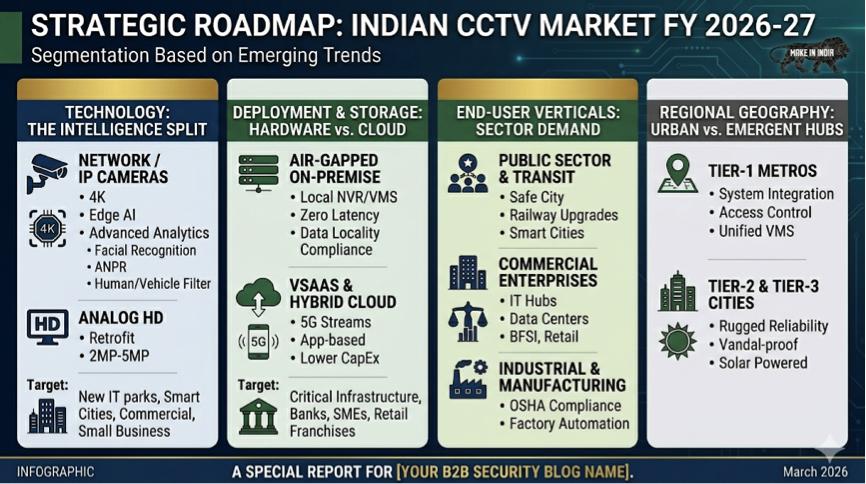
To build an effective B2B sales funnel or product roadmap, stakeholders must analyze the market across four primary segments.
1. By Technology. The Edge vs. The Core
The technology split dictates network infrastructure and bandwidth allocation.
- Traditional / Analog HD (High Definition). * The Status. Coaxial setups still hold legacy weight, but are rapidly being confined to retrofitting.
- B2B Focus. Smaller retail chains, older commercial buildings, and cost-sensitive warehousing looking to upgrade to 5MP clarity without tearing out existing cables.
- Network / IP (Internet Protocol) & Multi-Sensor Cameras. * The Status. The undisputed driver of new enterprise installations.
- B2B Focus. Greenfield IT parks, data centers, airports, and smart cities requiring 4K resolution, zero-light color imaging, and heavy onboard Edge-AI processing.
2. By Deployment & Storage (The CapEx vs. OpEx Split)
How data is stored is creating two very distinct financial and operational profiles for B2B buyers.
- Air-Gapped On-Premise (NVR/VMS Heavy). * The Profile. Heavy on-site hardware with local server clusters.
- Target Vertical. Critical infrastructure, BFSI (banking and ATMs), and government establishments where compliance mandates dictate that data must not leave physical premises or local networks.
- VSaaS (Video Surveillance as a Service) & Hybrid Cloud. * The Profile. Edge cameras streaming directly to centralized cloud repositories, bypassing local recorders.
- Target Vertical. Geographically dispersed businesses (e.g., QSR chains, retail franchises, micro-finance branches) wanting centralized monitoring, low upfront CapEx, and remote, automated firmware patching.
3. By End-User Enterprise Verticals
The application defines the camera specifications. In FY 2026-27, three specific sectors are driving bulk procurement.
| B2B Segment | Hardware & Feature Focus | Why They are Buying in FY 2026-27 |
| Public Sector & Transit | Rugged PTZ cameras, Thermal imaging, ANPR, Centralized Command Center VMS. | Safe City initiatives, highway toll automation, and Railway upgrades (massive station modernization). |
| Commercial Enterprises (IT, Real Estate, Retail) | Panoramic fisheye cameras, dome cameras with behavior analytics, visual heat-mapping. | Commercial real estate absorption, warehouse automation, and visual business intelligence (tracking retail footfall). |
| Industrial & Manufacturing | Explosion-proof cameras, corrosion-resistant hardware, thermal fire detection. | Industrial expansion, factory automation, and OSHA compliance (detecting if workers are wearing safety helmets). |
4. By Regional Geography (Metros vs. Emergent Hubs)
- Tier-1 Metropolitan Hubs. Demand is dictated by integration. Clients want open-platform VMS that unifies CCTV with Access Control, Fire Alarms, and Building Management Systems (BMS).
- Tier-2 & Tier-3 Smart Cities. Demand is dictated by rugged reliability. Growth here is massive, driven by municipal corporation tenders. Buyers prioritize solar-powered options for power-scarce zones and vandal-proof enclosures.
The Takeaway for B2B Stakeholders
Success in the FY 2026-27 Indian CCTV market will belong to those who stop selling “cameras” and start selling “computational intelligence.” Whether your B2B client is a municipal corporation tracking traffic or a retail brand tracking conversion rates, your surveillance hardware is simply the vehicle. The real product is the data.

Satyajit Roy is a senior security strategist, veteran Indian Navy aviator, and tactical visionary with over 40 years of defense and enterprise security expertise. After 25 years of decorated military service—including as Project Director for the IMS Vikrant Museum Ship—he now drives digital transformation in high-tech surveillance.
As the author of the premier electronic security blog ‘Fortia’ for SecuriTech and the ‘Surakshit Bharat Abhiyan’ initiative for national internal security, Satyajit champions AI-driven video analytics, zero-trust architectures, and self-reliant defense.
OSINT Note: This article relies exclusively on publicly available open-source intelligence. All insights are non-plagiarized, synthesized from industry reports, and cited transparently. Data is for informational purposes only; the author disclaims any liability for business decisions made herein.